
Technical capabilities

Security modules built for real system boundaries.

CyberAI engineers focused capabilities that can stand alone, connect to an existing stack, or become a validated work package inside a collaborative R&D project.

ModularEvidence-orientedLightweightPilot-aware
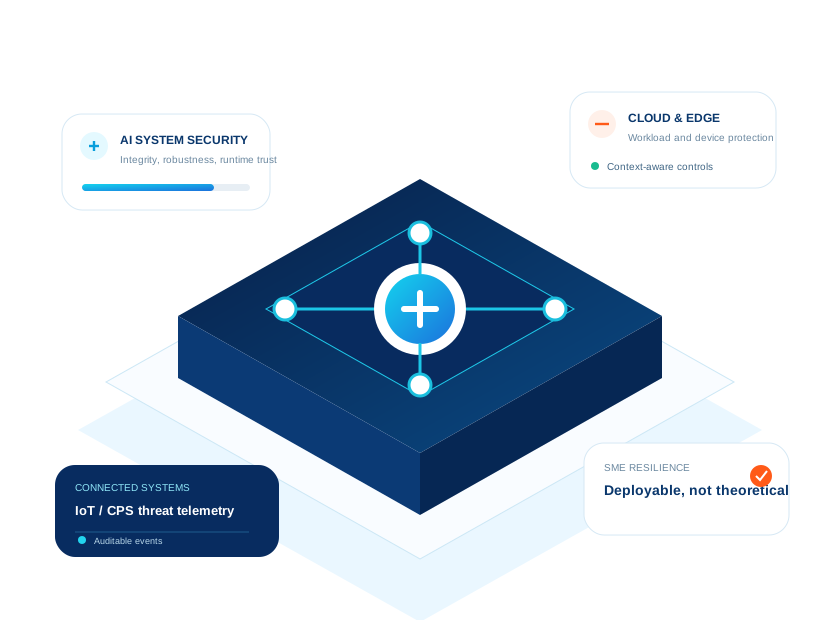
Layered CyberAI capability architecture
Capability architecture

Four domains. One evidence fabric.

The design prioritises auditable signals, explicit assumptions and integration points instead of a monolithic “AI security platform” claim.

01 / AI systems

Security of the AI lifecycle

Controls are mapped to training, validation, deployment and runtime behaviour.

P

Poisoning & backdoor defence

Threat models, provenance signals and validation tests for manipulated training data or model behaviour.

A

Adversarial robustness

Evaluation of perturbation sensitivity, unsafe boundaries and mitigation mechanisms.

R

Runtime assurance

Monitoring of drift, anomalous inputs and policy violations after deployment.

L

Privacy leakage assessment

Evidence-oriented analysis of exposure through models, APIs and inference workflows.
02 / Cloud & edge

Distributed security context

Workload, gateway and device evidence are connected without assuming enterprise-scale resources.

C

Cloud workload signals

Risk context for APIs, containers, services and identity-dependent interactions.

E

Edge-aware monitoring

Lightweight collection and local reasoning under latency, bandwidth and compute constraints.

D

DDoS / EDoS reasoning

Detection and mitigation logic for traffic abuse and cost-oriented resource exhaustion.

T

Traceable response

Evidence lineage from event detection to technical action and governance record.

03 / Connected assets

IoT and cyber-physical protection

Operational state matters. Device events are interpreted against process context.

I

Device identity & posture

Asset-specific context, behavioural baselines and security-relevant state changes.

M

Manipulation detection

Evidence for command abuse, actuator anomalies and unsafe state transitions.

B

Behavioural anomaly analysis

Lightweight methods for separating operational variation from suspicious deviation.

O

Operational integration

Interfaces for alerts, throttling, protective actions and incident workflows.

04 / SME resilience

Deployable security for constrained teams

Evidence must be understandable and implementation overhead must remain realistic.

S

Security baseline

Prioritised coverage aligned with the organisation’s actual assets and exposure.

R

Readable risk context

Technical signals translated into actionable information without removing uncertainty.

C

Compliance support

Structured evidence to support—not replace—formal regulatory and organisational processes.

I

Incident handling support

Clear routing, evidence preservation and decision support for small operational teams.

Integration philosophy

Independent modules. Shared traceability.

Each component has an explicit input, decision mechanism, output and validation boundary. This makes it possible to test a module before integrating it into a broader architecture.

API / event interfaceEvidence schemaPilot protocol
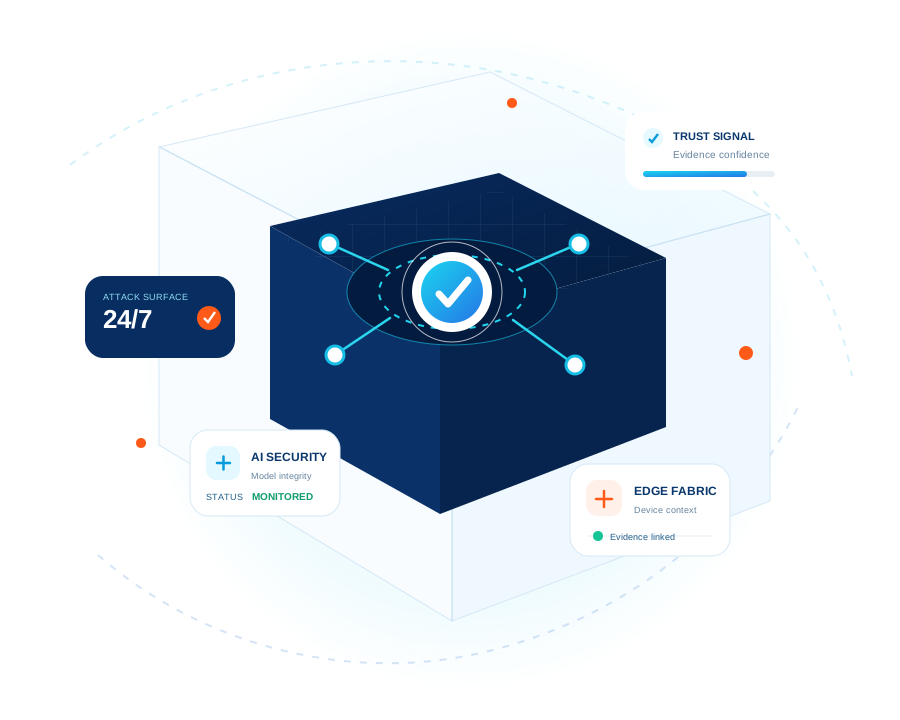
CyberAI modular integration fabric
Capability fit

Need a focused security module rather than a vague platform?

Send the system boundary and expected decision. CyberAI will identify the credible capability and evidence path.

Discuss the system